bydaniel rowles, lead trainer at bet伟德安卓下载 and author of digital branding (kogan page). last updated: november 2026.
to understandhow to start a career in marketingin 2026, accept one uncomfortable fact: ai now does many of the tasks that used to fill a junior marketer's week. the way in is to show employers you can do more than those tasks, with strong fundamentals, real ai fluency and a small portfolio that proves both.
the routes where demand is holding up best include apprenticeships, agencies and smaller in-house teams. this guide is for students, graduates and career changers. it explains what has changed, which routes into marketing are working now, what employers are looking for, and a 90-day plan you can start today. if you want a quick picture of your current skills, our freedigital marketing skills benchmarkis a useful first step.
how to start a career in marketing: is it still possible with ai?
yes, but it is harder than it was, and it needs a different approach. entry-level marketing jobs were traditionally built around drafting social posts, pulling reports together, researching competitors and handling campaign admin. those are exactly the tasks ai tools now handle well, so many employers are hiring fewer people to do them.
the evidence is consistent. asurvey of 225 us agency leaders reported by martechfound that 57% had slowed or paused entry-level hiring, while 75% were hiring for ai hybrid roles.gartner, reported by marketing dive, predicts that by 2030 ai will let most high-performing marketing teams remove traditional entry-level roles. in the uk, the institute of student employers foundgraduate hiring fell by 8% while apprentice hiring rose by 8%, and competition is fierce, witharound 140 applications per graduate role.
it is worth keeping this in proportion. theise has stressedthat its members are not reporting ai as the main reason for fewer student jobs; the wider economy plays a big part too. marketing still needs new talent, because today's juniors are tomorrow's strategists and leaders.
what has changed is the bar. employers now expect new starters to contribute at a higher level sooner, and to arrive already comfortable with ai.
what are the main routes into a marketing career?
there is no single right way in. each route has trade-offs, and the best choice depends on your circumstances, how you like to learn and the kind of marketing you want to do.
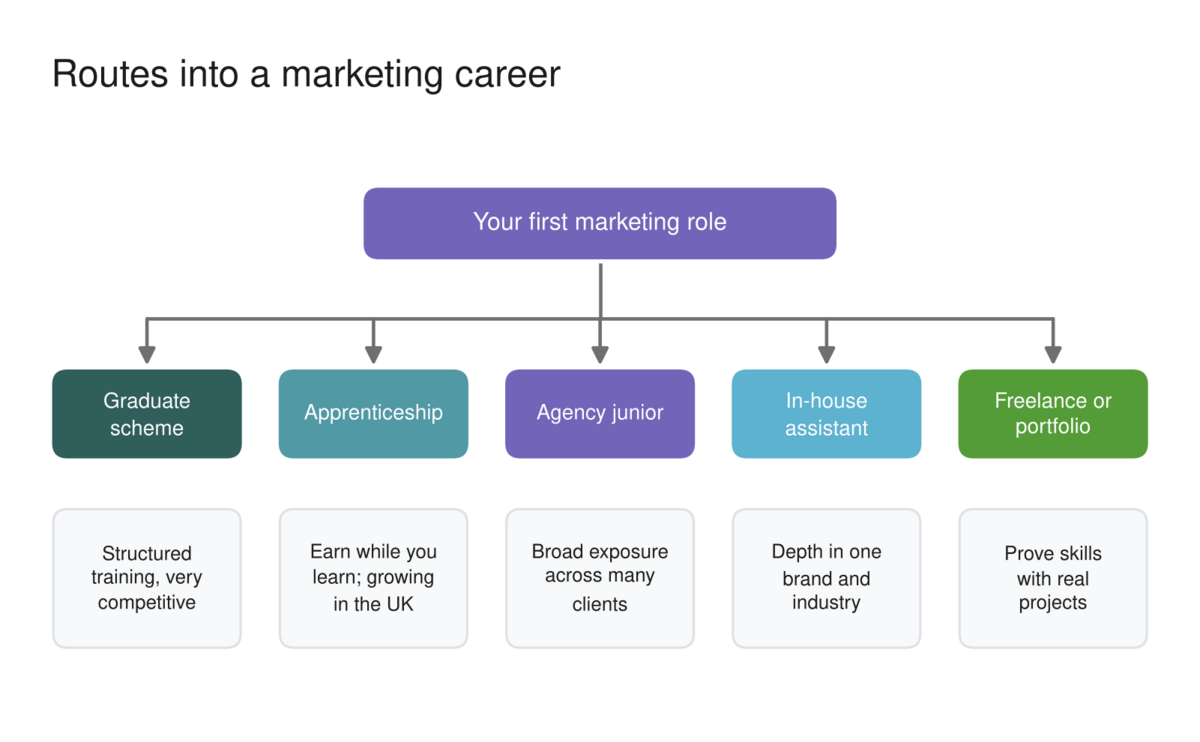
graduate schemesoffer structured training and rotation across teams, but they are highly competitive and numbers have fallen. apply early and treat each application as a piece of marketing in itself.
apprenticeshipslet you earn while you learn, with formal training alongside real work. they are growing in the uk and are open to people of any age, which makes them a strong option for career changers as well as school and college leavers.
agency junior rolesgive broad exposure to many clients, channels and deadlines. they are an excellent place to learn quickly, although agencies are among those slowing entry-level hiring, so expect competition.
in-house assistant or executive roles, especially in smaller organisations, often mean doing a bit of everything for one brand. they can be easier to get than big-brand graduate schemes and offer real responsibility early.
freelance and portfolio routesinvolve doing real projects for small businesses, charities or your own ventures. this is slower and less secure, but it builds exactly the evidence employers want, and it can lead directly to a permanent role.
whichever route you choose, the common thread is evidence. our guide tomarketing graduate jobs in the age of aicovers what employers look for in more detail.
what skills do you need to start a marketing career now?
you need three things working together: marketing fundamentals, practical ai fluency and the human skills that ai cannot supply.
fundamentalsmean understanding customers, positioning, the main channels and how marketing is measured. without them you cannot judge whether ai output is any good. a simple way to start is to build a customer persona with ourfree persona template tool, and to learn the basics of measurement with ourfree ga4 course on key events.
ai fluencymeans using ai tools confidently on real marketing tasks, writing clear prompts and checking the results. theamerican marketing association's 2026 careers reportadvises early-career marketers to show how they have used ai on real problems, including the process and the results, and to show their ai use becoming more sophisticated over time. our guide tothe ai skills every marketer needssets out a clear ladder to follow.
human skillsinclude curiosity, clear writing, resilience and the confidence to present your thinking. the ama also recommends building real depth in two or three areas rather than staying shallow across everything, which makes you more useful from day one.
what is a good 90-day plan to start a marketing career?
three months is long enough to make real progress and short enough to stay focused. the plan below assumes you can give it a few hours a week alongside study or another job.
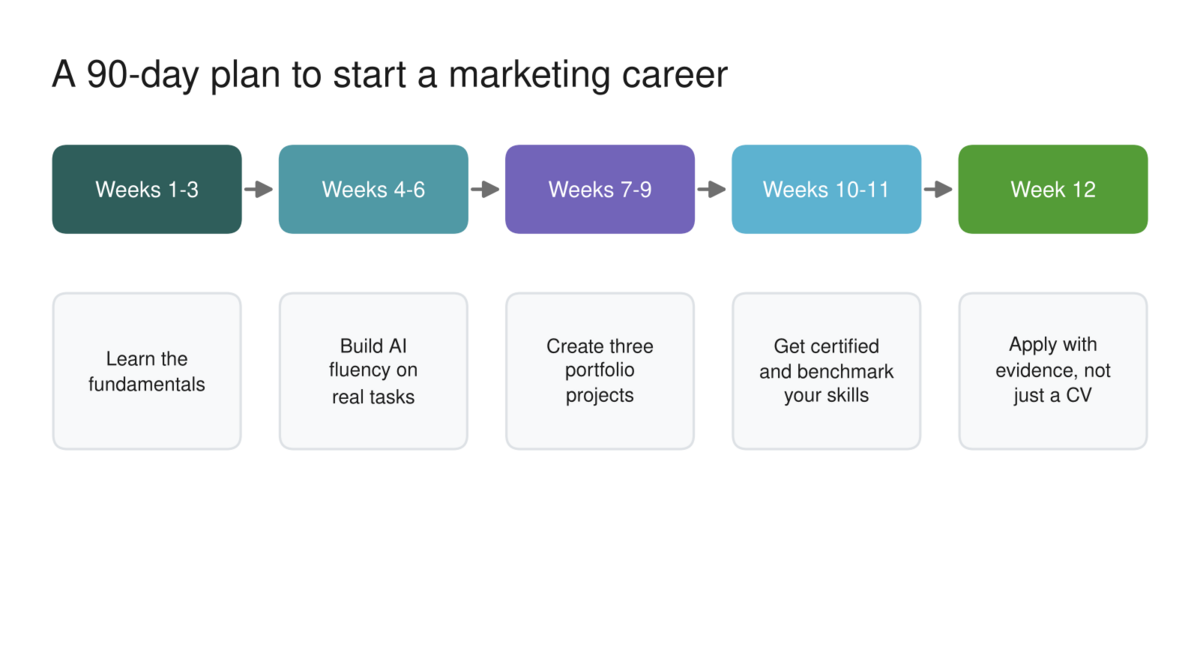
weeks 1 to 3: learn the fundamentals.work through a structured introductory course. our review of thebest online digital marketing courseswill help you choose. focus on understanding customers and channels rather than memorising tools.
weeks 4 to 6: build ai fluency on real tasks.use ai to help with genuine marketing work, such as analysing a brand's social media or drafting an email campaign. keep notes on what you had to correct.
weeks 7 to 9: create three portfolio projects.pick real brands, charities or local businesses and produce work that shows both your thinking and your ai skills. our guide tobuilding a marketing portfolio with ai when you have no experiencewalks you through this.
weeks 10 to 11: get certified and benchmark your skills.an accredited certificate and a benchmark score give employers independent evidence that you know what you are talking about.
week 12: apply with evidence, not just a cv.tailor each application, link to your portfolio and explain what you would do in the role. our older but still relevantdigital marketing recruitment tipscover the basics of standing out.
use ai to help you plan, but make sure the plan fits your real circumstances.
copy and paste prompt:"i want to start a career in marketing. my background is [education or previous work], i can spend [hours] a week on this, and i am most interested in [area of marketing, for example social media, content, analytics or brand]. create a personalised 12-week plan covering fundamentals, ai skills, three portfolio projects and job applications. for each week, give me one specific task, the output i should produce and how i will know it is good enough."
thebet伟德安卓下载 platformcan support each stage of this plan, with interactive courses across digital marketing and ai, skills benchmarking to show where your gaps are, accredited certification, over 400 episodes of the digital marketing podcast, and monthly live masterclasses.
frequently asked questions
can i start a career in marketing without a degree?
yes. marketing has always welcomed people from varied backgrounds, and skills-based hiring is increasing. pwc found the share of ai-exposed jobs requiring a degree fell from 64% to 56%. apprenticeships, certifications and a strong portfolio can all take the place of a degree.
is marketing still a good career to start in 2026?
yes, for people willing to work alongside ai. execution roles are shrinking, but strategic, creative and ai-fluent roles are holding steady or growing, and roles requiring ai skills attract a significant wage premium. starting with ai skills puts you ahead of many existing marketers.
what is the best entry-level marketing job?
the best first job is one where you will learn fast and get feedback. agency roles offer breadth, in-house roles offer depth in one brand, and apprenticeships combine training with real work. choose the environment that suits how you learn best.
how do i get marketing experience with no experience?
create your own. volunteer for a charity, help a local business, run social media for a club or build a project around a real brand. document the brief, what you did, how you used ai and the results, then present it as a portfolio case study.
should i specialise early in my marketing career?
build broad fundamentals first, then develop depth in two or three areas. this t-shaped approach makes you useful straight away while keeping your options open as ai continues to change which specialisms are in demand.
if you are ready to take a structured approach to building your digital marketing skills,explore bet伟德安卓下载 membership optionsand discover how the platform's interactive courses, benchmarking tools, podcast, accredited certification and live masterclasses can help you land your first marketing role with confidence.
about the author
daniel rowlesis lead trainer at bet伟德安卓下载 and the author ofdigital branding(kogan page). he co-hosts the digital marketing podcast and delivers digital marketing and ai training for organisations around the world, including digital transformation and future skills. you can find out more on hisbet伟德安卓下载 profile.
bibliography
1. martech (2025).ai is changing the hiring practices of marketing agencies.https://martech.org/ai-is-changing-the-hiring-practices-of-marketing-agencies/
2. marketing dive (2025).cmos must rethink entry-level talent as ai alters marketing needs: gartner.https://www.marketingdive.com/news/cmos-must-rethink-entry-level-talent-as-ai-alters-marketing-needs-gartner/831604/
3. fe news (2025).ise: apprenticeships rise as graduate vacancies drop 8%.https://www.fenews.co.uk/skills/ise-apprenticeships-rise-as-graduate-vacancies-drop-8-apprenticeship-hiring-increased-by-8
4. intergenerational foundation (2025).will ai take your graduate job?https://if.org.uk/2025/08/26/will-ai-take-your-graduate-job/
5. institute of student employers (2025).have graduate jobs really nosedived?https://ise.org.uk/knowledge/insight/446/have_graduate_jobs_really_nosedived
6. american marketing association (2026).2026 state of marketing careers report.https://ama.org/marketing-news/2026-career-report